Showing posts with label Exercise tips. Show all posts

Wednesday, May 2, 2012

How To Get Started Exercising


Exercise: How To Get Started
May 2, 2012
Do you wish someone could just tell you what kind of exercise to do? Do it for yourself!!
Choose an activity that you enjoy and that you can start slowly and increase gradually as you become used to it. Walking is very popular and does not require special equipment. Other good exercises include swimming, biking, jogging and dancing. Taking the stairs instead of the elevator or walking instead of driving may also be a good way to start being more active.
How long should you exercise?
Start off exercising 3 times a week (maybe start by walking your dog or walk with a friend) for 20 minutes or more, and work up to at least 30 minutes, 3 to 4 times a week. Exercising with a friend or a family member can help make it fun, and having a partner to encourage you can help you stick to it and maybe do more!
How hard should you exercise?
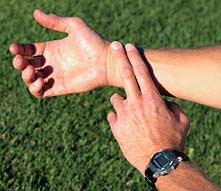
As you become more used to exercising, try to keep your heart rate at about 60% to 85% of your "maximum heart rate."

To keep things simple use three zones or training intensities:

1. Easy/Recovery = 60 – 70%
2. Endurance/Strength = 71 – 80%
3. Strength/Long hills = 81 – 85%

To calculate your HRR take your Maximum Heart Rate as determined by a test or Estimated Maximum Heart Rate determined by (220-age) and subtract your Resting Heart Rate.  In terms of a formula, HRR=MHR - RHR.  Now that you have your HRR we can calculate your THR or training zones.  
 

Example: Subtract resting heart rate from maximum heart rate to get heart rate reserve (HRR)

MHR (220-49) – RHR (71) = HRR (101)
171 – 71 = 101
101 x .60 + 71= 131
101 x .70 + 71= 141
101 x .80 + 71 = 151
101 x .90 + 71 = 161
HRR X % + RHR = Intensity of workout

 Multiply HRR by 60 – 80% of your maximum heart rate which will set your upper and lower range limits:

Table 1: THR Zones Using Karvonen Method

ZONE
Formula
Calculated HRs
1
Lower limit = HRR x .6 + RHR
Upper limit = HRR x .7 + RHR
Lower = _______ bpm
Upper = _______ bpm
2
Lower limit = HRR x .71 + RHR
Upper limit = HRR x .8 + RHR
Lower = _______ bpm
Upper = _______ bpm
3
Lower limit = HRR x .81 + RHR
Upper limit = HRR x .85 + RHR
Lower = _______ bpm
Upper = _______ bpm
4
Lower limit = HRR x .86 + RHR
Upper limit = HRR x .9 + RHR
Lower = _______ bpm
Upper = _______ bpm
5
Lower limit = HRR x .91 + RHR
Upper limit = HRR x 1.0 + RHR
Lower = _______ bpm
Upper = _______ bpm


Feel free to contact me (Nancy @ nlarson@co.delaware.in.us  or my.healthiswelth@comcast.net,) if you need help getting started!!


Wednesday, March 28, 2012

Exercise: How To Get Started

It can be hard to motivate ourselves to exercise, especially if it's been awhile since our last trip to the gym.  Here are answers to some common questions people have about starting (or re-starting) to incorporate physical activity into their weekly routine.


What kind of exercise should I do?

Choose an activity that you enjoy and that you can start slowly and increase gradually as you become used to it. Walking is very popular and does not require special equipment. Other good exercises include swimming, biking, jogging and dancing. Taking the stairs instead of the elevator or walking instead of driving may also be a good way to start being more active.


How long should I exercise?

Start off exercising 3 times a week for 20 minutes or more, and work up to at least 30 minutes, 3 to 4 times a week. Exercising with a friend or a family member can help make it fun, and having a partner to encourage you can help you stick to it.


How hard should I exercise?

As you become more used to exercising, try to keep your heart rate at about 60% to 85% of your "maximum heart rate."

To figure out your target heart rate, subtract your age (in years) from 220. This is your maximum
heart rate. Now, to calculate your target heart rate, multiply that number by 0.60 or 0.85.


For example, if you are 40 years of age, you would subtract 40 from 220, which would give you a maximum heart rate of 180 (220 - 40 = 180).  Then you would multiply this number by either 0.60 or 0.85, which would give you a target heart rate range of 108 to 153 beats per minute.  (180 x 0.60=108 and 180 x 0.85=153).

Wednesday, February 15, 2012

Eating Before Exercising


Wellness Wednesday~
February 15, 2012


Did you know what you eat before you exercise actually depends on when you exercise. You have to eat to nourish your body, which also provides you the energy you need to do your workout and to help you recover from it. I sometimes don’t want to eat anything before a workout thinking it will make me feel sick, instead I usually feel weak and cannot complete the routine with full steam.  Mayo clinic tries to clarify some questions and concerns on eating before exercise:

  • You will want to eat a combination of low-glycemic carbohydrates such as whole-grain bread, some protein or vegetables if you exercise later in the morning or day.
  • You may be a person who exercises in the morning 10 to 15 minutes after rising, chances are you don’t really need or feel like eating anything until you finish your workout.
  • If your workout lasts less than 30 to 40 minutes, you may want to drink a few glasses water before your workout.
  • You need to have some juice, a few pieces of fruit or bring some juice with you to drink during your workout if your workout lasts longer than 40 minutes.  
  • If you are hungry an hour before your workout, have a small smoothie with protein, frozen fruit and yogurt, or fruit and nuts.

After a workout, your body is starving for nourishment, so kick-start the healing process and adaptation of muscle growth with fresh fruit with yogurt, or any light combination of protein and carbohydrates.

For more healthy tips, contact Nancy Larson @ my.healthiswealth@comcast.net

Thursday, September 22, 2011

Bike & Walk to Work month!


Join kids and families around the globe to walk and bicycle to school in October!
National Walk & Bike to School Day - October 5th


This year October 5th is the official day, however, the entire month of October is considered national Walk & Bike to School Month.  The Delaware County Wellness Coalition supports this along with representatives of the Health by Design Coalition http://www.healthbydesignonline.org/and the Indiana State Department of Health (http://www.in.gov/isdh/).  
International Walk to School in the USAhttp://www.walktoschool.org/images/hikeit_bikeit_ilikeit.jpg
Ten reasons you should start walking now:

1. Walkers Live Longer

2. Walking Helps Prevent Weight Gain

3. You Can Walk Off Weight

4. Walking Reduces Risk of Cancer

5. Walking Reduces Risk of Heart Disease and Stroke

6. Walking Reduces Diabetes Risk

7. Walking Boosts Your Brain Power

8. Walking Improves Mood and Relieves Stress

9. Walking Can Prevent Erectile Dysfunction

10. It's Easy to Get Started Walking

Friday, September 16, 2011

Exercise Tips


What kind of exercise should I do?
Choose an activity that you enjoy and that you can start slowly and increase gradually as you become used to it. Walking is very popular and does not require special equipment. Other good exercises include swimming, biking, jogging and dancing. Taking the stairs instead of the elevator or walking instead of driving may also be a good way to start being more active.


How long should I exercise?
Start off exercising 3 times a week for 20 minutes or more, and work up to at least 30 minutes, 3 to 4 times a week. Exercising with a friend or a family member can help make it fun, and having a partner to encourage you can help you stick to it.


How hard do I have to exercise?
As you become more used to exercising, try to keep your heart rate at about 60% to 85% of your "maximum heart rate."

To figure out your target heart rate, subtract your age (in years) from 220. This is your maximum heart rate. Now, to calculate your target heart rate, multiply that number by 0.60 or 0.85.

For example, if you are 40 years of age, you would subtract 40 from 220, which would give you a maximum heart rate of 180 (220 - 40 = 180). Then you would multiply this number by either 0.60 or 0.85, which would give you 108 or 153 (180 x 0.60=108 and 180 x 0.85=153).